
Journal
What If the Sitar Could Play Chords?
This chapter shows how the question of drones, harmony, and foot control became the Harmonic Sitar project, joining tradition, robotics, and Afro-Raga.
What If the Sitar Could Play Chords?
When the world reopened, I returned to Israel and tried to step back into a normal rhythm. I was performing again, working, and rebuilding a sense of balance after the strange stillness of the pandemic years.
Then, in late 2023, I left for what was supposed to be a short, one-month trip.
The war began.
Flights stopped, and I suddenly found myself stranded in Nepal, watching events unfold at home from thousands of kilometers away. In the middle of that chaos, I fell in love with someone whose world was supposed to be on the opposite side of mine. For a while, we lived inside a fragile bubble, checking the news of the war while trying to build something ordinary in a place where those borders did not seem to matter.
We survived on music and improvisation. We played wherever we could, blending Persian songs, Indian ragas, and Hebrew melodies—sometimes on stage, sometimes simply to create an hour of ground that did not feel like it was shaking.
But eventually, the weight of the outside world caught up with the fragile reality we had built.
When that chapter ended, I faced a choice. I could return to a safer path—or finally attempt the idea that had been circling in my mind for years: building the instrument I kept hearing in my head.
I chose the second.
For years, the programmer and mathematician in me had been quiet. He showed up occasionally, in the way I structured a setlist, in the obsessive precision of my raga practice, in the architecture of a website I built myself. But the two halves of my life still felt separate.
Then the sitar broke the wall between them.
The sitar has five drone strings that play a constant note. Traditionally, they are tuned before the performance and stay fixed. That works perfectly in Indian classical music, where the raga stays centered around one tonal universe.
But when I started playing with kora players, jazz musicians, and electronic artists, those fixed drones began to feel like a cage. Playing Afro-Raga raised another question: what if the sitar itself could follow those shifting harmonies?
And little by little, that question sharpened and turned into a more radical one: what if the sitar could actually play chords?
The truth is, this idea didn’t appear suddenly. It had been circling in my mind for years. Sometimes as a vague thought, sometimes as a sketch in a notebook. But for a long time it remained just that — a thought, something I might try to build one day.
Then, at some point, it stopped being a thought and became an obsession.
What if the drone strings could be controlled dynamically with the foot, while the hands kept playing? I called the idea the Harmonic Sitar: a traditional instrument with a robotic layer, controlled through a small floor keyboard.
I took the idea to Rikhi Ram, the greatest sitar maker in India. His family has been building sitars for generations. He looked at me and said: "You are a smart guy, but I am not sure this is realistic." I came back with a prototype and a design. He was turned on. His family has its own tradition of innovation. They had already created the Zitar, a sitar with electric guitar pickups.
Then came iCreate, an Indian research institute and startup accelerator. I presented the Harmonic Sitar at a conference. I even bought a suit for the occasion. A couple of months later, they called: "Come as a mentor. Work on your project. Take some funding." In parallel, I was collaborating with Kartikeya Vashist, a bansuri player, on a musical project, and touring with the Raga Fusion Project, an Indian band where I was the only Israeli, and the only one playing sitar while everyone else played Western instruments.
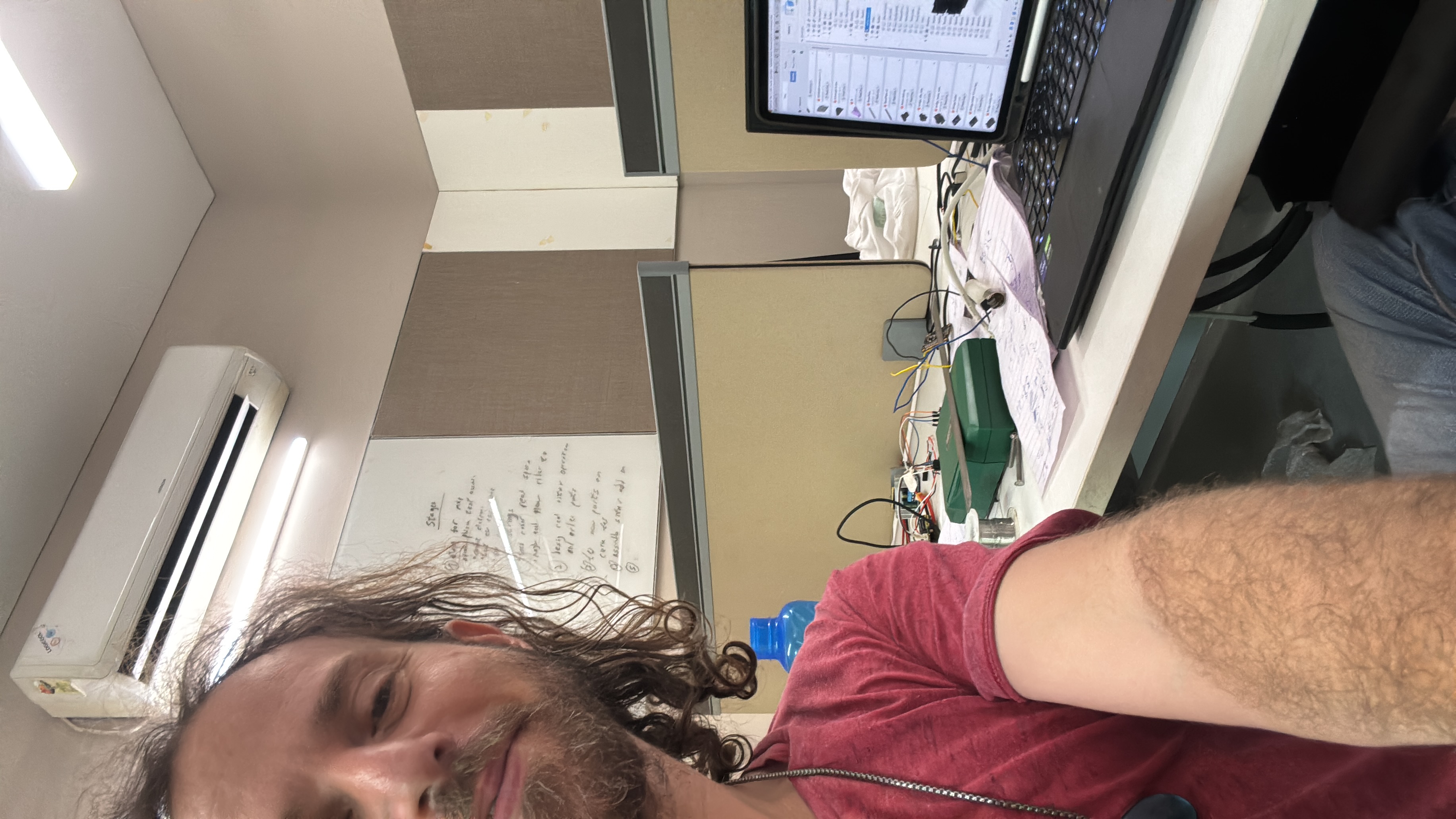
I spent two months at iCreate in what felt like a tech monastery, a room in nature, three meals a day, nothing to do but build.
There are moments, at 2 AM, when you sit in a lab and ask yourself: what am I doing? Why can I not be a normal person who goes to work in the morning? But after years of war and uncertainty, after watching how quickly everything can be taken away, building the Harmonic Sitar stopped being just a project. It became a lifeline. I have always believed something: better a spectacular failure than a life spent dreaming about things you never try.
I became a musician, only to realize I had to become an engineer again to build the instrument I needed.
Haaretz covered the story when I landed back in Israel after eight months, the sitar player who is also a robotics expert, returning from a journey that was equal parts musical and technological.