
Journal
Dharamsala: The Instrument Finds Me
This chapter follows the first encounter with the sitar in Dharamsala, the early study years, East Africa, and the beginning of a life stretched between engineering, India, and musical traditions.
Dharamsala: The Instrument Finds Me
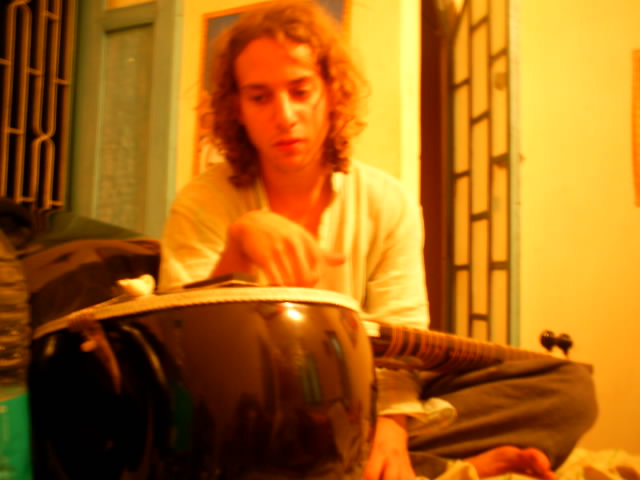
I arrived in Dharamsala in 2006 with nothing but a guitar and curiosity. I took a few classes, tabla, sitar, the way travelers do, sampling everything. But the moment I heard the sitar up close, something locked into place. I just knew. I wanted to play this instrument.
My teacher was Arvind Singh. I was naive. I had no idea how demanding the sitar was, how many years it would take, how deep the tradition ran. In the beginning I could barely produce a clean note. The instrument fought me constantly. But the struggle only made the pull stronger. I certainly did not imagine that this instrument would reshape my entire life. After two months in Dharamsala, I followed Arvind to Varanasi to continue studying, and that is where I got my first sitar.
I came home to Israel with it.
The Double Life Begins
In 2007, I enrolled in mathematics and computer science at Ben-Gurion University. On paper, I was becoming an engineer. In reality, I was already living between two worlds that did not quite fit together. I arrived at BGU already changed. I had a sitar, a new musical obsession, and the memory of India pulling at me constantly.
At BGU, while my classmates were debugging code, I was rehearsing with Ensemble El Matruz, an Arab Israeli band, playing sitar alongside Arab instruments. The quarter tones, the modal systems, the way a melody could spiral around a single emotional center for minutes without resolution, it felt like a continuation of what I had begun in India, translated into a Middle Eastern language.
During one summer break, I went back to Dharamsala, this time to volunteer at a Tibetan refugee camp, and to continue my sitar studies. India kept calling. I kept answering. But I also kept returning to the algorithms.
I did not know it yet, but I was tracing a path eastward, from Arab music to Indian raga to, eventually, West African traditions. The double life was not a problem to solve. It was the engine.
The double life was not a problem to solve. It was the engine.
East Africa
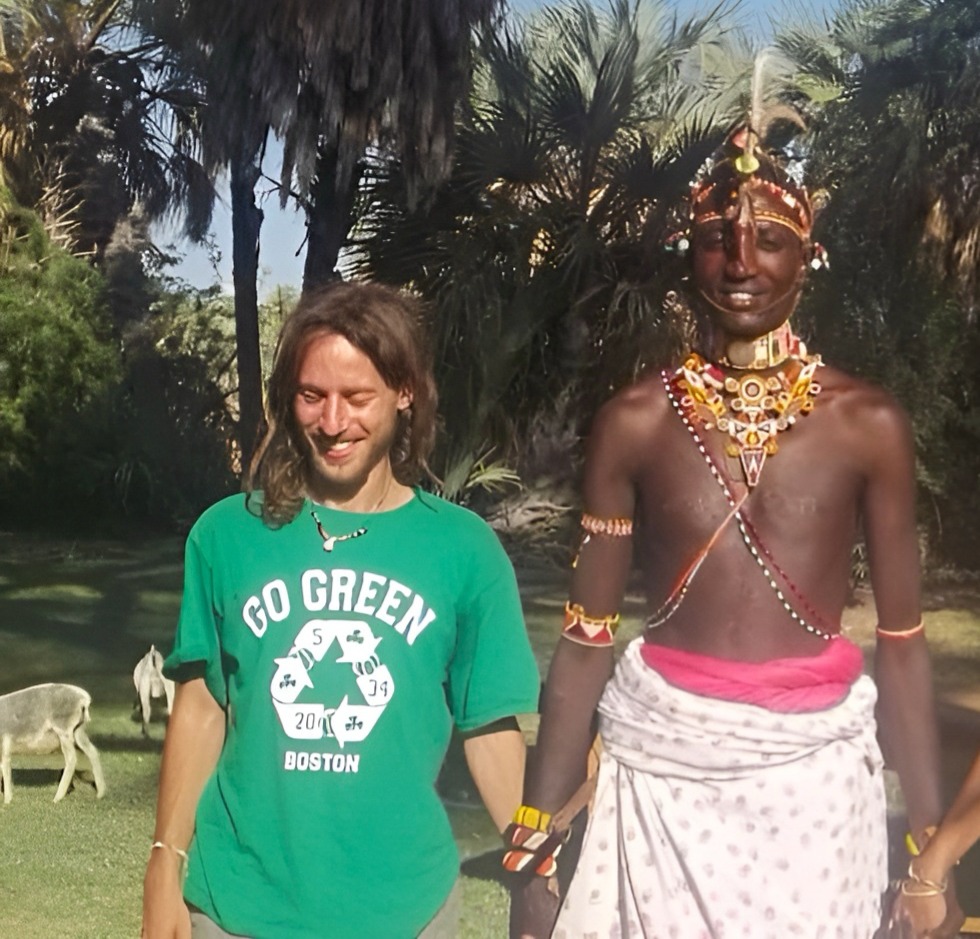
I finished my degree in 2010 and immediately left for East Africa, Ethiopia, Kenya, Tanzania, Malawi. Not a career move. A continuation of the searching.
The most transformative moment happened in the most desolate place I have ever been: Lake Turkana, in northern Kenya. No safety net. I traveled there by foot and camel, guided by local people.
We ended up in Loiyangalani, where we spent time with the Samburu tribe. I had long hair, and I introduced myself as a traveler from the Judea tribe, which they recognized from missionaries and Bible stories. It made sense to them. We became friends.
What struck me most was the music. The Samburu had no instruments at all. Everything came from the voice, one singer leading, the rest building rhythm and harmony around it. Then everyone would dance, the famous jumping-as-high-as-you-can dance that puts you into a trance. Men and women together. Pure music from nothing.
I did not have the word for it then, but what I experienced at Lake Turkana was the raw power of African musical tradition: collective, physical, trance-inducing.
Years later, when I heard a kora next to a sitar for the first time, something from that night at Lake Turkana came back to me. The connection was not intellectual. It was lived. Only later did I realize that this was the beginning of what I would call Afro-Raga.
I came home from Africa in early 2011. A few months later, the tents went up on Rothschild Boulevard.